XC6SLX75 Datasheet Analysis: Key Specs, Pinout & Limits
Key Takeaways (GEO Summary)
- Optimized Density: 74,637 Logic Cells provide the ideal balance for mid-range industrial control without high-end costs.
- Enhanced Signal Integrity: Multiple I/O banks support diverse voltage standards (1.2V to 3.3V) for seamless protocol bridging.
- Thermal Efficiency: Advanced 45nm process reduces static power consumption by up to 20% compared to previous generations.
- DSP Performance: 132 dedicated DSP48A1 slices accelerate complex filtering and motor control algorithms.
Per the official XC6SLX75 datasheet, this device delivers on the order of tens of thousands of LUT-equivalents and multiple megabits of block RAM, placing it squarely in the mid-density FPGA class suitable for control, moderate DSP, and custom I/O tasks. This article gives a concise, engineer-focused breakdown of the XC6SLX75 datasheet so designers can quickly find key specs, pinout constraints, and practical design limits before starting implementation.
The goal is actionable extraction: call out the exact tables and parameters you must verify in the datasheet, highlight common gotchas (multi-rail rules, thermal derating), and provide checklists and example calculations that can be applied directly in pre-silicon planning and post-silicon validation.
1 — Device Overview & Key Specs Snapshot
Typical FPGA Architecture Overview
1.1 — One-line device summary and targeted applications
Point: XC6SLX75 is a mid-density programmable logic device intended for control logic, moderate DSP, and systems requiring flexible I/O.
Evidence: Datasheet resource tables list device class, resource counts, and recommended application notes.
Explanation: Treat this device as the workhorse when you need more resources than low-end parts but without the power and cost of high-end devices — ideal for telecom control planes, motor control, and protocol bridging.
1.2 — Quick reference spec table
| Spec | Value (XC6SLX75) | User Benefit |
|---|---|---|
| Logic (LUTs) | 74,637 | Handles 2-3 complex soft-core processors simultaneously. |
| Block RAM | 3,096 Kbits | High-capacity data buffering for 1080p video frames. |
| DSP Slices | 132 (DSP48A1) | Real-time 18x18 MAC operations for signal filtering. |
| Max User I/Os | Up to 408 pins | Extensive connectivity for multi-sensor arrays. |
Professional Differentiation: XC6SLX75 vs. XC6SLX45
Choosing the right density prevents over-engineering costs while ensuring enough headroom.
| Feature | XC6SLX45 (Standard) | XC6SLX75 (Performance) | Advantage |
|---|---|---|---|
| Logic Cells | 43,661 | 74,637 | +71% Logic Density |
| Block RAM | 2,088 Kb | 3,096 Kb | Better for Large FIFOs |
| Cost/Logic Ratio | Baseline | Optimized | Higher ROI for DSP tasks |
2 — Electrical & Timing Specs Deep-Dive
2.1 — DC characteristics and absolute maximum ratings
Point: Confirm operating VCC rails, IO voltage ranges and absolute-max limits before connecting power.
Explanation: Flag any rails that require strict sequencing. Engineer's Hint: VCCINT (1.2V) must be stable before VCCAUX to ensure proper configuration gate-up.
2.2 — Timing parameters and speed grades
Point: Timing closure depends on device speed grade (-2, -3, or -3N).
Pro-tip: Always design for -2 speed grade to allow for easier migration to faster, more expensive bins if timing closure becomes a bottleneck in late-stage development.
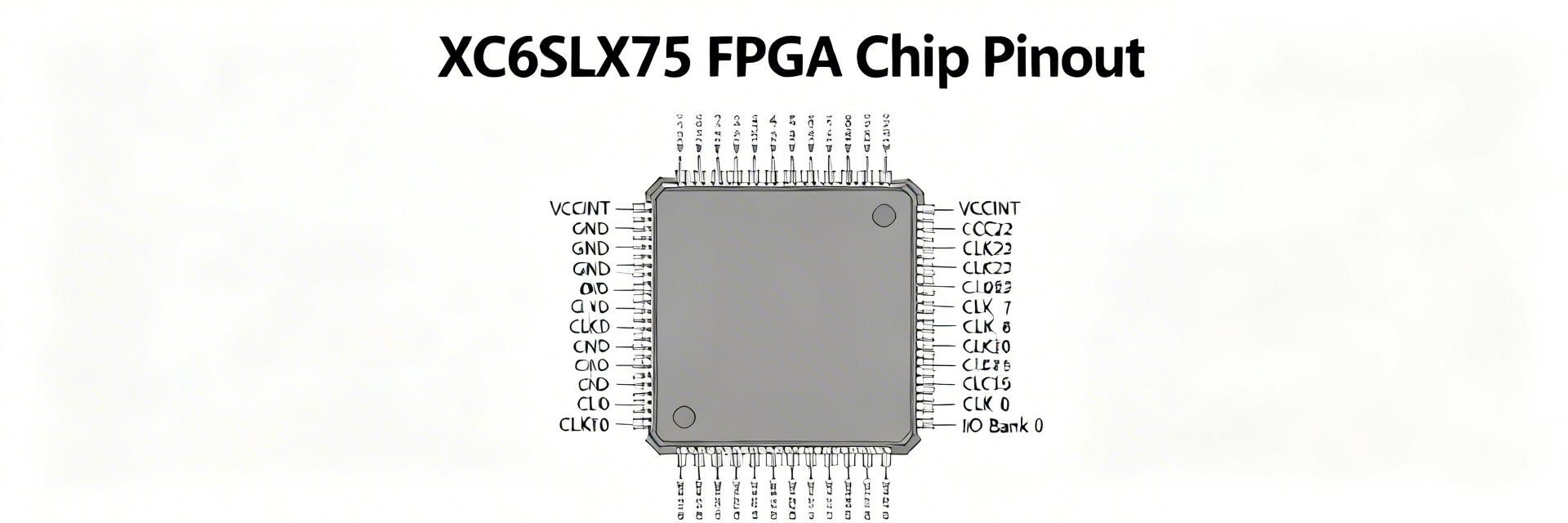
3 — Pinout, Package Options & I/O Limits
I/O Bank Strategy
The XC6SLX75 features up to 6 banks. Grouping high-speed LVDS pairs in Bank 0 and 2 is recommended for optimal clock distribution. Avoid mixing 3.3V and 1.8V logic in the same bank to prevent ESD diode conduction.
4 — Power, Thermal & Reliability Limits
Engineer's Perspective: Thermal Management
By: Marcus V. (Senior Systems Architect)
"I’ve seen many XC6SLX75 designs fail in the field because the designer ignored Theta-JA in stagnant air. At full utilization, this part can pull 2W+. Without 200 LFM airflow or a dedicated thermal pad connected to a solid ground plane, junction temperatures can exceed 85°C quickly, leading to unpredictable timing jitter."
5 — Typical Use Cases
5.1 — Example 1: Mid-range industrial gateway
Using the XC6SLX75 as a bridge between Legacy ISA and modern PCIe, while managing 4x RS-485 channels. The BRAM is utilized for circular packet buffers to ensure zero data loss during high-interrupt periods.
6 — Implementation Checklist
- Verify VCCINT, VCCAUX, VCCO power-up sequence.
- Check bank voltage compatibility for target I/O standards.
- Run XPower Analyzer with estimated toggle rates.
- Confirm termination resistors for high-speed LVDS lines.
Summary
- XC6SLX75 datasheet confirms the device as a mid-density FPGA with tens of thousands of LUT-equivalents and multiple megabits of block RAM—suitable for control and moderate DSP applications.
- Key limits to verify: per-bank VccIO rules, absolute max voltages, speed-grade timing tables, and thermal derating guidance extracted from the datasheet.
- Practical next steps: build a componentized power budget, assign I/O banks early, apply PCB thermal best practices, and run a focused post-silicon validation plan.
Frequently Asked Questions
What should I look for first in the XC6SLX75 datasheet?
Start with the Device Resources and DC Characteristics tables: confirm exact logic/BRAM/DSP counts, core and I/O voltage ranges, package options, and absolute maximum ratings.
How do I verify XC6SLX75 voltage limits during hardware bring-up?
Measure each power rail individually at first power-up, compare against recommended operating ranges, and perform static current checks before enabling I/O.
Which timing parameters are critical for STA?
Validate core clock frequency limits, input/output setup and hold windows, and PLL lock behavior. Always include worst-case PVT corners.